Here we solve the LAWE numerically using a 2<sup>nd</sup>-order accurate, [[Appendix/Ramblings/51BiPolytropeStability/BetterInterfacePt2#Convert_to_Implicit_Approach|implicit integration scheme]].
Here we solve the LAWE numerically (on a uniformly zoned mesh — different <math>\Delta\tilde{r}</math> for the separate core/envelope regions) using a 2<sup>nd</sup>-order accurate, [[Appendix/Ramblings/51BiPolytropeStability/BetterInterfacePt2#Convert_to_Implicit_Approach|implicit integration scheme]] in which the LAWE is broken into a pair of 1<sup>st</sup>-order ODEs. These results should be compared against a separate [[SSC/Stability/BiPolytropes/SuccinctDiscussion#Stability|succinct discussion]] of our analysis obtained from integrating the LAWE in its standard 2<sup>nd</sup>-order ODE form.
Here we construct and analyze the relative stability of a bipolytrope in which the core has an polytropic index and the envelope has an polytropic index.
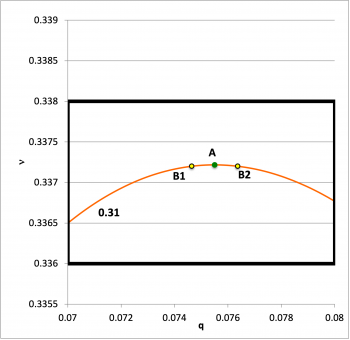
file = Dropbox/WorkFolder/Wiki edits/Bipolytrope/Stability/qAndNuMax.xlsx --- worksheet = B-KB74 thru MinuPreparationBipolytrope with Selected Pairings along the Sequence
Pairing
A
B1
B2
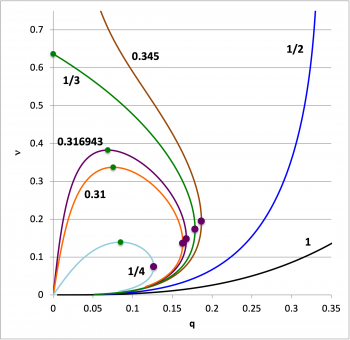
Bipolytropic (5, 1) Equilibrium Sequences
Bipolytropic (5, 1) Equilibrium Sequences
Stability
Here we solve the LAWE numerically (on a uniformly zoned mesh — different for the separate core/envelope regions) using a 2nd-order accurate, implicit integration scheme in which the LAWE is broken into a pair of 1st-order ODEs. These results should be compared against a separate succinct discussion of our analysis obtained from integrating the LAWE in its standard 2nd-order ODE form.