Here we construct and analyze the relative stability of a bipolytrope in which the core has an polytropic index and the envelope has an polytropic index.
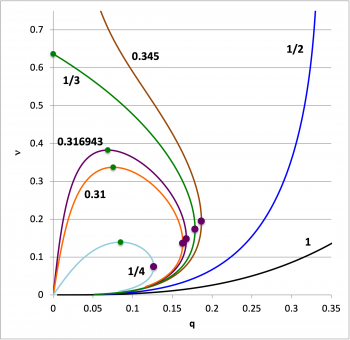
Maximum Fractional Core Mass, (solid green circular markers) for Equilibrium Sequences having Various Values of
LHS
RHS
---
---
---
---
---
---
---
0.0
0.0
0.33
24.00496
0.0719668
0.0710624
0.2128753
0.0726547
1.8516032
-223.8157
-223.8159
0.038378833
0.52024552
0.0
0.316943
10.744571
0.1591479
0.1493938
0.4903393
0.1663869
2.1760793
-31.55254
-31.55254
0.068652714
0.382383875
0.0
0.31
9.014959766
---
---
0.59835053
---
---
---
---
0.0755022550
0.3372170064
0.0
0.3090
8.8301772
0.1924833
0.1750954
0.6130669
0.2053811
2.2958639
-18.47809
-18.47808
0.076265588
0.331475715
0.0
4.9379256
0.3309933
0.2342522
1.4179907
0.4064595
2.761622
-2.601255
-2.601257
0.084824137
0.139370157
0.0
Recall that,
and
Also, go here for definition of , which identifies the location of the specific-entropy step function; stability against convection is ensured whenever .
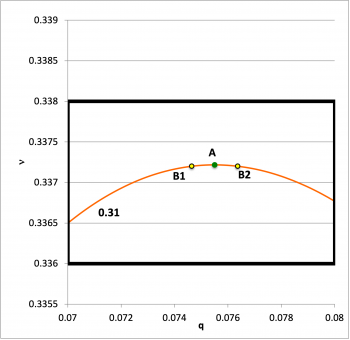
file = Dropbox/WorkFolder/Wiki edits/Bipolytrope/Stability/qAndNuMax.xlsx --- worksheet = B-KB74 thru MinuPreparationBipolytrope with Selected Pairings along the Sequence
Pairing
A
B1
B2
Bipolytropic (5, 1) Equilibrium Sequences
Bipolytropic (5, 1) Equilibrium Sequences
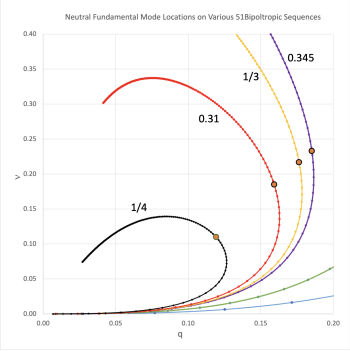
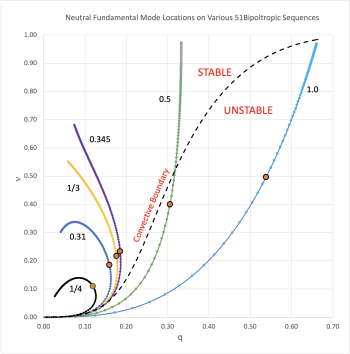
Bipolytropic (5, 1) Neutral Fundamental Mode Locations
Bipolytropic (5, 1) Equilibrium Sequences
Stability
Introduction & Summary
Here we solve the LAWE numerically (on a uniformly zoned mesh — different for the separate core/envelope regions) using a 2nd-order accurate, implicit integration scheme in which the LAWE is broken into a pair of 1st-order ODEs. These results should be compared against a separate succinct discussion of our analysis obtained from integrating the LAWE in its standard 2nd-order ODE form.
Properties of Neutral Fundamental Mode for Various Sequences
σc2 for Overtones
Ω2 for Overtones
1st
2nd
1st
2nd
1.000
1.6639103365
8.4811731
0.49622717
0.53833097
0.000000
2.528013
5.66087
10.72026
24.0054
0.500
2.2703111897
62.666493
0.399760079
0.305764976
0.000000
0.2659116
0.73022
8.33187
22.8802
0.345
2.546385206
205.77394
0.232779379
0.185262833
0.000000
0.06741185
0.198075
6.93580
20.3793
2.5675774773
225.75664
0.216806201
0.176420918
0.000000
0.0602615
0.178432
6.80222
20.1411
2.6095097538
270.59221
0.184909369
0.159274
0.000000
0.04821396
0.145248
6.52316
19.6515
2.712384289
415.67338
0.109935743
0.1192667
0.000000
0.02772424
0.088472
5.76211
18.3877
Model Sequence: μe/μc = 1.00
Marginally Unstable Model
Numbers presented in the following table should be compared against our earlier determinations. Various things to note:
As discussed elsewhere — for example, here — when , the radial displacement function for the core — that is, for all — should be given precisely by the expression,
Hence, given that ξi = 1.6639103365 as viewed from the perspective of the core, the magnitude of, and the logarithmic derivative of the radial displacement function should have the values, respectively,
and
As discussed elsewhere — for example, here — we expect,
file = Dropbox/WorkFolder/Wiki edits/BiPolytrope/TwoFirstOrderODEs/Bipolytrope51.xlsx --- worksheet = MuRatio100FundOur September 2023 Determinations for Marginally Unstable Model Having