H BookTiledMenu: Difference between revisions
| Line 396: | Line 396: | ||
! style="height: 150px; width: 150px; background-color:#ffeeee; border-right:2px dotted black;" |[[Apps/MaclaurinSpheroids/GoogleBooks#Excerpts_from_A_Treatise_of_Fluxions|Maclaurin's<br />Original Text<br />&<br />Analysis<br />(1742)]] | ! style="height: 150px; width: 150px; background-color:#ffeeee; border-right:2px dotted black;" |[[Apps/MaclaurinSpheroids/GoogleBooks#Excerpts_from_A_Treatise_of_Fluxions|Maclaurin's<br />Original Text<br />&<br />Analysis<br />(1742)]] | ||
| | | | ||
! style="height: | ! style="height: 200px; width: 200px; border-right:2px dashed black;" |[[File:Maclaurin01.gif|300px|link=Apps/MaclaurinSpheroids/GoogleBooks#Prolate_Spheroid|Our Construction of Maclaurin's Figure 291Pt2]] | ||
| | | | ||
! style="height: 150px; width: 150px; background-color:maroon;" |[[Apps/MaclaurinSpheroidSequence|<font color="white">Maclaurin<br />Spheroid<br />Sequence</font>]] | ! style="height: 150px; width: 150px; background-color:maroon;" |[[Apps/MaclaurinSpheroidSequence|<font color="white">Maclaurin<br />Spheroid<br />Sequence</font>]] | ||
Revision as of 21:01, 12 September 2021
Tiled Menu

|
|---|
ATTENTION: You may need to alter your browser's magnification (zoom out and/or widen its window, for example) in order to view the most orderly layout of the "menu tiles" on this page.
Context
| Global Energy Considerations |
|---|
| Principal Governing Equations (PGEs) |
Continuity | Euler | 1st Law of Thermodynamics |
Poisson |
|---|
| Equation of State (EOS) |
Ideal Gas | Total Pressure Bond, Arnett, & Carr (1984) |
|---|
Spherically Symmetric Configurations
| (Initially) Spherically Symmetric Configurations |
|---|

|
Structural Form Factors |
Free-Energy of Spherical Systems |
|---|
| One-Dimensional PGEs |
|---|
Equilibrium Structures
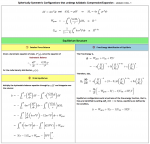
| 1D STRUCTURE |
|---|
|
Scalar Virial Theorem |
|---|
| Hydrostatic Balance Equation |
|
Solution Strategies |
|---|

| Uniform-Density Sphere |
|---|
| Isothermal Sphere |
|
via Direct Numerical Integration |
|---|
| Isolated Polytropes |
Lane (1870) |
|
Known Analytic Solutions |
via Direct Numerical Integration |
via Self-Consistent Field (SCF) Technique |
|---|
| Zero-Temperature White Dwarf |
Chandrasekhar Limiting Mass (1935) |
|---|
| Virial Equilibrium of Pressure-Truncated Polytropes |
|---|
| Pressure-Truncated Configurations |
Bonnor-Ebert (Isothermal) Spheres (1955 - 56) |
Embedded Polytropes |
Equilibrium Sequence Turning-Points ♥ |

|
Turning-Points (Broader Context) |
|---|
| Free Energy of Bipolytropes (nc, ne) = (5, 1) |
|---|
| Composite Polytropes (Bipolytropes) |
Milne (1930) |
Schönberg- Chandrasekhar Mass (1942) |
Murphy (1983) Analytic (nc, ne) = (1, 5) |
Eggleton, Faulkner & Cannon (1998) Analytic (nc, ne) = (5, 1) |

|
|---|
Stability Analysis
| 1D STABILITY |
|---|
Three different approaches are used in the study of hydrodynamical stability of stars and other gravitating objects …
- The first approach is based on the use of the equations of small oscillations. In that case the problem is reduced to a search for the solution of the boundary-value problem of the Stourme-Liuville type for the linearised system of equations of small oscillations. The solutions consist of a set of eigenfrequencies and eigenfunctions. The following set of menu tiles include links to chapters where this approach has been applied to: (a) uniform-density configurations, (b) pressure-truncated isothermal spheres, (c) an isolated n = 3 polytrope, (d) pressure-truncated n = 5 configurations, and (e) bipolytropes having .
- Second, one can derive a variational principle from the equations of small oscillations. Below, an appropriately labeled (purple) menu tile links to a chapter in which the foundation for this approach is developed. With the aid of the variational principle, the problem is reduced to the search of the best trial functions; this leads to approximate eigenvalues of oscillations. In spite of the simplifications introduced by the use of the variational principle and by not solving the equations of motion exactly, the problem still remains complicated … One menu tile, below, links to a chapter in which an analytic (exact) demonstration of the variational principle's utility is provided in the context pressure-truncated n = 5 polytropes.
- The third approach is what we have already referred to as a free-energy — and associated virial theorem — analysis. When this method is used, it is not necessary to use the equations of small oscillations but, instead, the functional expression for the total energy of the momentarily stationary (but not necessarily in equilibrium) star is sufficient. The condition that the first variation of the energy vanishes, determines the state of equilibrium of the star and the positiveness of a second variation indicates stability.
If one wants to know from a stability analysis the answer to only one question — whether the model is stable or not — then the most straightforward procedure is to use the third, static method … For the application of this method, one needs to construct only equilibrium, stationary models, with no further calculation. Generally the static analysis gives no information about the shape of the modes of oscillation, but, in the vicinity of critical points, where instability sets in, this method makes it possible to find the eigenfunction of the mode which becomes unstable at the critical point. Generally in what follows, this will be referred to as the "B-KB74 conjecture;" a menu tile carrying this label is linked to a chapter in which this approach is used to analyze the onset of a dynamical instability along the equilibrium sequence of pressure-truncated n = 5 polytropes.

|
Variational Principle |
|---|
| Radial Pulsation Equation |
Example Derivations & Statement of Eigenvalue Problem |
(poor attempt at) Reconciliation |
Relationship to Sound Waves |
|---|
 |
 |
 |
|---|
| Uniform-Density Configurations |
Sterne's Analytic Sol'n of Eigenvalue Problem (1937) |

|
|---|
| Pressure-Truncated Isothermal Spheres |
|
via Direct Numerical Integration |

| |||||||
|---|---|---|---|---|---|---|---|---|---|---|
| Yabushita's Analytic Sol'n for Marginally Unstable Configurations (1974) |
|
|---|
| Polytropes |
|
Isolated n = 3 Polytrope |

| |||||||
|---|---|---|---|---|---|---|---|---|---|---|
| Exact Demonstration of B-KB74 Conjecture |
Exact Demonstration of Variational Principle |
|---|
| Pressure-Truncated n = 5 Configurations |

|
|---|
| Our (2017) Analytic Sol'n for Marginally Unstable Configurations ♥ |
|
|---|
| B-KB74 Conjecture RE: Bipolytrope (nc, ne) = (5, 1) |
|---|
| BiPolytropes | Murphy & Fiedler (1985b) (nc, ne) = (1,5) |
Our Broader Analysis |
|---|
Nonlinear Dynamical Evolution
| 1D DYNAMICS |
|---|
| Free-Fall Collapse |
|---|
| Collapse of Isothermal Spheres |
via Direct Numerical Integration |
Similarity Solution |
|---|
| Collapse of an Isolated n = 3 Polytrope |
|---|
Two-Dimensional Configurations (Axisymmetric)
| (Initially) Axisymmetric Configurations |
|---|
| Storyline |
|---|
| PGEs for Axisymmetric Systems |
|---|
Axisymmetric Equilibrium Structures
| 2D STRUCTURE |
|---|
| Constructing Steady-State Axisymmetric Configurations |
Axisymmetric Instabilities to Avoid |
Simple Rotation Profiles |
Hachisu Self-Consistent-Field [HSCF] Technique |
Solving the Poisson Equation |
|---|
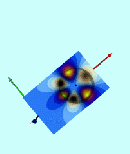
| Using Toroidal Coordinates to Determine the Gravitational Potential |

|
Attempt at Simplification ♥ |
Wong's Analytic Potential (1973) |
|
|---|
Spheroidal & Spheroidal-Like
| Uniform-Density (Maclaurin) Spheroids |
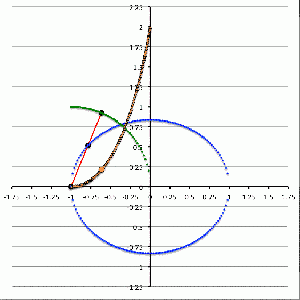
Maclaurin's Original Text & Analysis (1742) |
|
Maclaurin Spheroid Sequence |
|---|
| Rotationally Flattened Isothermal Configurations |
Hayashi, Narita & Miyama's Analytic Sol'n (1982) |
Review of Stahler's (1983) Technique |
|---|
| Rotationally Flattened Polytropes |
Example Equilibria |
|---|
| Rotationally Flattened White Dwarfs |
Ostriker Bodenheimer & Lynden-Bell (1966) |
Example Equilibria |
|---|
Toroidal & Toroidal-Like
See Also
|
|
|---|
|
Appendices: | VisTrailsEquations | VisTrailsVariables | References | Ramblings | VisTrailsImages | myphys.lsu | ADS | |